
What Allegany Deeds Convey
Deeds in Allegany County are recorded by the Circuit Court Clerk's Land Records Department. Each record shows the parties and the recording date. It also lists the form of conveyance and the legal description. Many also list the consideration and a reference to an earlier deed. The recorded text governs. An index entry by itself will not reveal a reserved life estate or a corrected description. It also will not show a partial-interest transfer. Nor will it flag a conveyance made through a trustee or estate representative.
| Deed Type | What It Does | Common Use |
|---|---|---|
| Warranty deed | Conveys the stated interest with deed warranties | Ordinary arm's-length transfer |
| Quitclaim deed | Conveys whatever interest the grantor has | Interest cleanup or family transfer |
| Special-warranty deed | Uses warranties limited by its terms | Some commercial or fiduciary sales |
| Trustee or executor deed | Conveys through a named legal capacity | Trust, estate, or court-linked transfer |
| Corrective deed | Repairs specified text in an earlier instrument | Name or description correction |
Deeds share the land index with mortgages, deeds of trust, assignments, releases, liens, judgments, lis pendens, easements, leases, and powers of attorney. Any of these can encumber a parcel without conveying it. MDLandRec's index does not flag every mortgage subtype either. Open the scanned image to be sure.
Search Allegany Deeds Online
MDLandRec is Maryland's official, free portal for land-record indexes and images. It is reached through a personal account. Pick Allegany County first. Home users must register, while the courthouse search room may log in automatically. From a result, click an instrument type or book/page to open the image. The electronic index can display or print the instrument PDF.
| Control | Accepted approach | Why it helps |
|---|---|---|
| Name | Last, first, middle, suffix | Find individuals with match choices |
| Party role | Grantor, grantee, or all | Separate giving from receiving |
| Ownership | Individual, corporation, or all | Reach entity-indexed names |
| Date | Range, before, after, or exact date | Narrow a common name |
| Citation | Book and page | Jump to a known Allegany deed |
| Other text | Capacity, remarks, reference | Find trustee or linked-record clues |
Depending on the field, name matching offers exact, begins with, ends with, contains, fuzzy, and Soundex options. A typical result lists the recording date, grantor and grantee, instrument type, book and page, remarks, and an information control. The official Maryland land-record entry screen shows how the gateway looks.
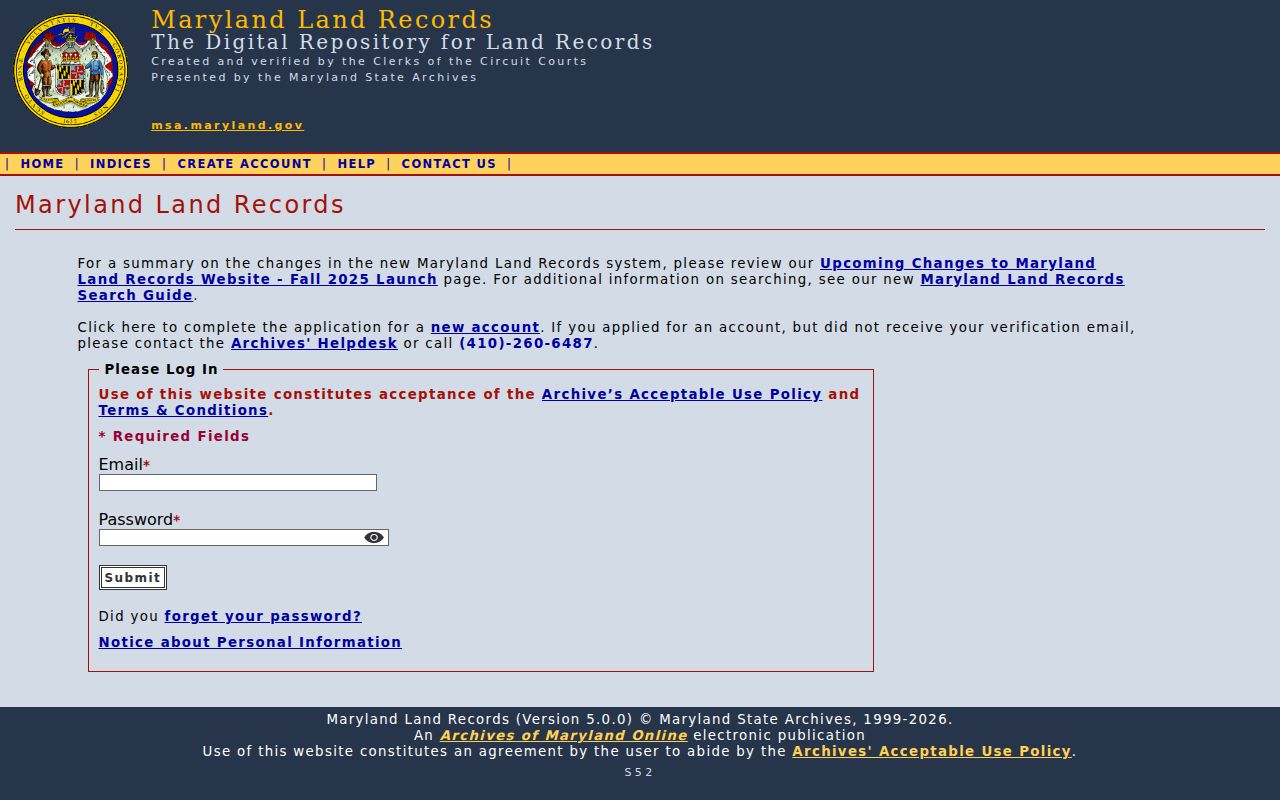
After signing in, select Allegany and work through a party search or the direct book/page route.
Walk Allegany's Grantor-Grantee Chain
The grantor conveys the interest; the grantee takes it. Walk a chain backward from the most recent deed. Find where that grantor acquired the parcel before it. Many deeds help by citing the prior conveyance in a "being the same as" clause. Copy that book and page before leaving the image.
- Find the current roll parcel in SDAT and copy its deed reference.
- Open that Allegany deed and record every grantor, grantee, capacity, date, and legal description.
- Follow its prior book/page reference. If it fails, search the current grantor as an earlier grantee.
- Compare the description and plat reference at each step so a same-name party does not lead to another parcel.
- Switch to historical indexes, deed books, microfilm, or Archives series when the electronic path ends.
- Grantor
- The party transferring the stated interest.
- Grantee
- The party receiving that interest.
- Chain of title
- The ordered set of instruments that traces recorded ownership.
- Book/page
- The volume and page citation used to retrieve a recorded image.
- Instrument number
- A separate filing identifier that may appear in a modern index.
Name variants, ET AL entries, trusts, estates, and corporate names can break a simple chain. Search both roles and check legal capacity before assuming two hits are the same person.
Allegany Books Reach 1791
The electronic index is not the whole story. Its grouped data starts later: COTT in 1984, CAIS in 1993, and ELOI in 2004. Maryland State Archives holds Allegany land-record indexes and original series reaching back to 1791. These include CE79 and CE187, plus paper and microfilm copies. A modern name search can look complete while missing an older ownership chain. When a book and page is already known, MDLandRec's Historical Indices or "Jump to New Volume" moves straight to it. The Archives Guide for Allegany County catalogs each series and its media. If a retrieval stalls, note the county, year, book, page, series, and reel. Then contact the Archives Help Desk or the Clerk. Note: Allegany has no documented courthouse disaster creating a named land-record gap. So treat a failed portal search as a search failure, not record loss.
Read Allegany Legal Descriptions
A street address is only a convenience. The deed may describe land by metes and bounds, lot and block, subdivision or plat, courses along a road or stream, an easement, right-of-way, mineral clause, or old tract name. Metes and bounds means measured courses, distances, and physical calls. Transcribe it in full before shortening anything. Allegany's legal language often echoes its National Road, rail, canal, river, coal, and mining geography. Those calls can point to an older plat or an adjoining deed. PLATS.NET preserves county land-record plats, subdivision plats, military lots, certificates, division plats, state-road plats, and survey collections, searchable by book, page, box, right-of-way, description, date, or series. The plat search interface brings those historical collections on screen.
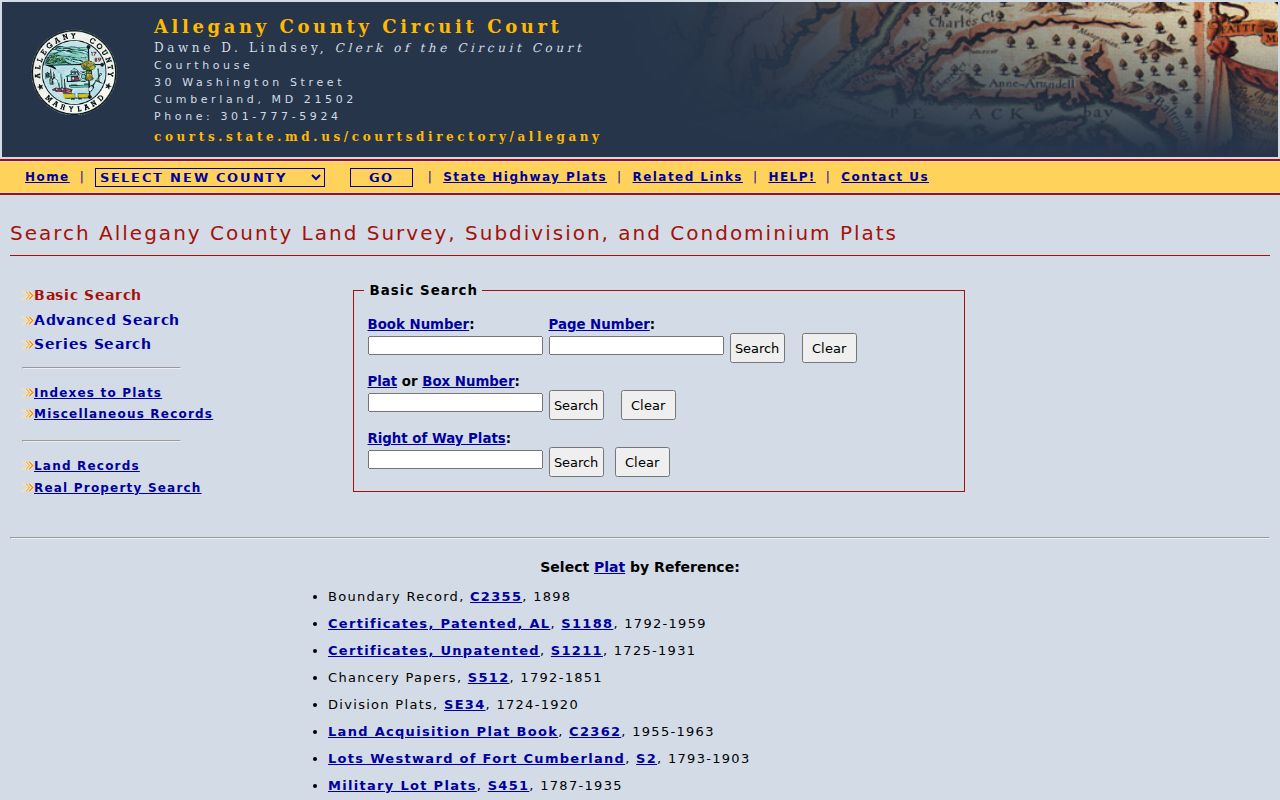
A plat clarifies the deed's geometry. Still, no web image or tax map replaces a current boundary survey.
Deeds and Encumbrances Diverge
A deed says who conveyed what recorded interest. A mortgage or deed of trust secures a debt instead. An assignment shifts the holder of that security interest. A release or satisfaction shows it was discharged. Judgments, lis pendens, mechanic's liens, leases, and easements each carry their own effect. Each may demand a second index or court file. Maryland's Judgment and Liens Search takes person or company, name, county, and filing-date fields. Case Search offers public summaries rather than full files. Allegany civil coverage listed by the Judiciary begins June 2, 1997. Older or complete files sit with the Circuit Court Clerk. Federal matters go through PACER.
Monitor New Allegany Filings
Free monitoring through MDLandRec is the tool Maryland Insurance recommends. Allegany County runs no fraud-alert signup of its own. A private paid alert service is not an official county tool, so treat it accordingly. Deed fraud is rising. The Allegany Circuit Clerk testified about it in 2025. That testimony is a sign the risk is real here.
Act fast when a suspicious deed appears. Preserve the document citation. Compare the image against the parcel. Also compare it against the prior chain of title. Then contact the Clerk, your lender, your title insurer, law enforcement, or the Attorney General as the facts call for. The Clerk can hand you the record itself. But deciding whether a deed is forged is beyond the office, and so is legal advice.
Obtain an Allegany Deed Copy
An electronic-index search can open and print a full instrument PDF. A direct book/page search works differently. It may show one page at a time. Batches can run up to ten pages. Maryland Courts guidance lists ordinary deed copies at $0.50 per page, while certification and recording charges should be confirmed with the Clerk before you rely on them. Ask whether an online print meets your intended use. Some recipients require a certified copy instead.
The Land Records Department is at 30 Washington Street in Cumberland, and the desk answers at 301-777-5924. Counter hours run Monday through Friday, 8:30 a.m. to 4:30 p.m. The Clerk's general page prohibits courthouse photography by phone or other device. Ask staff about permitted copies and terminal use. For book/page and copy questions, call Land Records directly. Skip the generic county PIA request. The county PIA office expressly excludes deeds, mortgages, real estate, and land records from county-government custody.
Older material lives elsewhere. The Archives holds paper, microfilm, and electronic series. WHILBR, the Allegany College Appalachian Collection, the Genealogical Society, and historical newspapers can help you chase a name or a tract clue. None of them replaces the recorded deed itself.
Mail and phone requests work best when they name Allegany County and supply the book, page, instrument type, party names, and approximate recording date. Ask the office to confirm the page count, copy charge, certification charge, delivery method, and payment form before you send funds. The Clerk cannot build your chain of title. If your citation came from an old index, keep that index page or series reference so staff can reproduce the search path.
Report any index error with the same precise citation details. The Archives Help Desk asks for county, year, book, and page when an image or link turns out wrong. A failed image does not prove the instrument was never recorded. The cause may be an index mismatch, an unreadable scan, a retired series, or a volume that must be retrieved through the counter or the Archives.
Recorded, not guaranteed. Allegany County deed records show filed instruments, not every possible unrecorded right or defect. Only a qualified title professional can give a title opinion.
Public access has to stay lawful. Never use a deed or mailing address to track someone, harass them, or defeat a protected substitute address. Keep the citations and land descriptions. Leave out unrelated signatures and private identifiers.
A plain copy reproduces the record, while certification is a separate clerk service that attests to the copy, so confirm which form the receiving party requires.