
The Allegany County Owner-of-Record Card
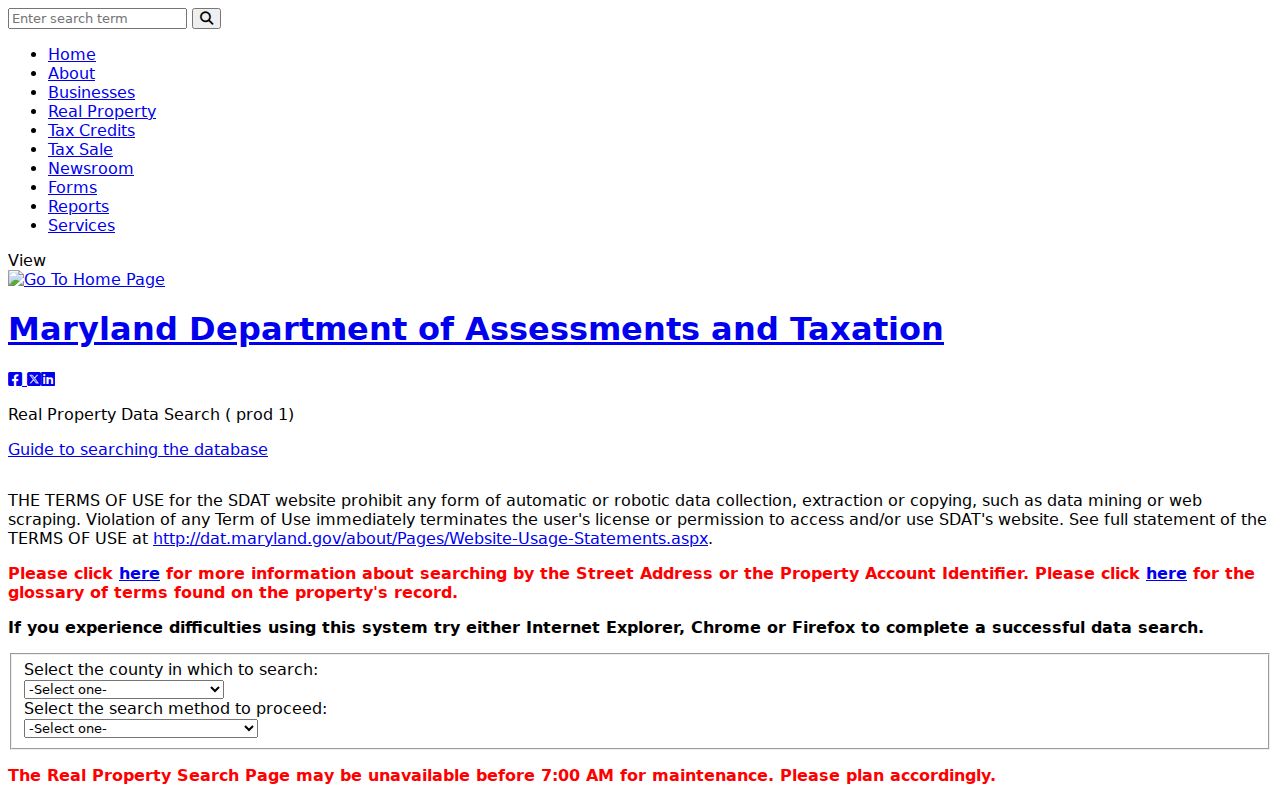
The SDAT Real Property Data Search starts the hunt for the Allegany County current owner. Pick Allegany County first. Choices include street address, account, map, or sales criteria. Owner names won't work as a starting key. Once a parcel opens, its Owner Information and transfer fields supply this present-tense record card:
| Owner Name | The person, joint owners, estate, trust, government, or entity carried on the assessment roll |
|---|---|
| Mailing Address | The destination for assessment correspondence; it is not proof of residence |
| Premises Address | The situs of the assessed parcel, which may differ from the mailing address |
| Account and Map/Grid/Parcel | Identifiers that keep the owner answer attached to the right land |
| Deed Reference | The book/page lead for checking the recorded conveyance |
| Transfer Date and Seller | Context for the latest displayed transfer, subject to the record's update timing |
A sample SDAT result puts the Owner Name and mailing address on one side and a styled premises address on the other, with a deed reference close by. That separation matters. The owner of record is not necessarily the occupant. A tax-mail destination is not a residence finding either.
The official sample Allegany parcel card shows the fields together:
Anchor every conclusion to the parcel itself. The displayed account number and deed reference keep a current-owner finding tied to this land record on this inspection date.
Check How Fresh the Allegany County Owner Record Is
SDAT's guidance says the system updates daily. No official source promises a fixed closing-to-roll interval. Daily maintenance is not the same as instant deed posting. A deed recorded this morning in Allegany County may sit in the land records for a while. It may not have changed the Owner Name yet. Save your inspection date. Then compare the card's transfer date and deed reference against the newest land-record entry.
Recent-sale gap. A newly recorded deed can be more current than the assessment roll. Treat the newest recorded conveyance as the stronger public evidence of a completed transfer, while remembering that neither portal supplies an insured title opinion.
Separate Mailing Address From Allegany County Situs
The two SDAT labels do different jobs. Premises Address marks the parcel. Mailing Address is where assessment correspondence goes, which could be a post-office box, an office, a trustee address, or somewhere outside Maryland. Principal Residence and homestead indicators remain tax and occupancy clues, never proof that a named person is physically present at the Allegany County property.
- Owner of record
- The party currently displayed on the public assessment roll.
- Assessment roll
- SDAT's administrative parcel record used for assessment information.
- Situs
- The location of the land, distinct from the owner's mailing destination.
- Recording lag
- The interval during which a deed may be recorded before another system reflects it.
Read Entity, Trust, Estate and ET AL Names Carefully
Ownership in Allegany County often hides behind entity names. An LLC, trust, or municipality can hold title. So can an estate, or a name followed by ET AL. Copy the exact string rather than expanding it silently. For a Maryland company, the Maryland Business Express Entity Search accepts a business name, Department ID, or EIN and may return filing history for most documents after August 2001. A filing names the organization and its public contacts. It does not prove beneficial ownership of the real estate. Trust and estate capacity comes from the deed itself, and from probate records where they apply.
Confirm the Current Allegany County Owner
Use the roll as a present-owner lead. Confirm with the recorded deed. The county Clerk holds deed records at 30 Washington Street in Cumberland, while MDLandRec provides free index and document-image access after account creation.
- Find the parcel in SDAT and copy Owner Name, account number, premises address, deed reference, and inspection date.
- Choose Allegany in MDLandRec and open the cited book/page; also check for a later conveyance under the parties' names.
- Read the deed image for grantee, legal capacity, recording date, legal description, and the interest actually conveyed.
- If the owner is a Maryland entity, cross-check its exact name in Business Express; if it is an estate, consult Estate Search and the recorded transfer.
- Grantee
- The party receiving the interest described by a recorded deed.
- Vesting
- The deed language stating who takes the interest and in what capacity.
- Registered agent
- A public entity contact, not necessarily the property's occupant or beneficial owner.
Use the Deed Reference Without Rebuilding a Title Search
MDLandRec results show recording date, parties, instrument type, book/page, and remarks, with links to scanned images. The task here is narrow. Verify the deed reference names that owner as grantee. Then check for a later deed. Walking the whole historical chain belongs on the former owners page, and Maryland's Clerk expressly does not perform title searches or give legal advice.
Account for Parcel Splits and Municipal Labels
Splits, merges, condominium conversions, and tax-map corrections can spawn a new account while the deed still cites a parent tract. Copy leading zeroes every time. Record both forms too: district/account and map-grid-parcel. A Cumberland, Frostburg, or Westernport mailing label does not prove the land sits inside that municipality, since ZIP geography and incorporated boundaries differ. Check the polygon in Allegany County Maps. Keep the legal description attached to whatever owner statement you produce.
Protected Addresses and Responsible Owner Statements
Maryland's Safe at Home Address Confidentiality Program gives eligible survivors a substitute address and mail forwarding. That shield deserves respect. Never use public records to defeat it. A responsible statement says the SDAT displayed this Owner Name on this inspection date, cites the deed checked, and infers nothing about household members, physical presence, or a hidden address.
Reach an Allegany County Property Owner Lawfully
A boundary question, easement, purchase offer, or other legitimate property matter justifies contact. Use the public mailing address on the roll. Name the parcel in your letter. Do not assume the addressee lives at the premises. When legal notice, ownership rights, or service requirements are involved, get professional guidance rather than trusting ordinary mail.
Lawful use. Public owner information supports legitimate property research; it is not permission to stalk, harass, intimidate, or expose a protected address. Verify the current owner with the custodian before acting.